


Over the past few weeks, I’ve been wrestling with three decisions in front of me at the same time. Not small ones.
Should I buy an investment property on my street?
Which relationships should our family of nine prioritize when we literally cannot do everything?
Is it a bad idea to compete in a Brazilian Jiu Jitsu tournament after a shoulder injury sent me to the ER a few months ago? (Yes, probably, but I really want to anyway!)
None of these has an obvious right answer, but all of them have long-term consequences.
The bigger challenge I’m facing is this:
Most of us have never been taught how to think about decisions, only how to make them.
We default to instinct. Emotion. Pragmatism. Whatever gets us back to equilibrium the fastest.
But I’m convinced that for God-fearing men, there’s a completely different operating system available, one that changes not just what you decide, but what your decisions are for.
What Decisions Are For
Here’s what I mean. Take any significant decision you’re facing right now (i.e. a financial call, a parenting moment, a career crossroads, a conflict with your wife) and notice how you’re approaching it.
Most men, even good Christian men, run decisions through a filter that sounds something like this:
What’s best for me and my family? What do I want to do with my time and money? What’s the smartest choice? What gives me the best outcome right now?
There’s nothing necessarily wrong with those instincts, but they’re incomplete. They treat decisions as problems to be solved rather than as training for something far more significant.
An aspiring elder (remember, by “elder” I don’t mean the guy who passes offering plates at church, I mean a man who is deliberately cultivating the kind of character that qualifies him for increasing responsibility) asks completely different questions.
Instead of, “What’s best for me and my family?” he asks, “How does this decision align with “seeking the Kingdom” (Matt. 6:33) and my role as a father?”
Instead of, “What do I want to do with my time and money?” he asks, “How can I manage what God has entrusted to me so that it produces fruit?”
Instead of, “What’s the smartest choice?” he asks, “Where is the Spirit directing me, even if it doesn’t make sense?”
Instead of, “What gives me the best outcome now?” he asks, “How does this decision prepare me for greater responsibility in the Kingdom to come?”
Same decisions, but an entirely different framework. And the difference matters more than most of us realize. Why?
Because the progression in scripture for a God-fearing man is to be a father in the home and then an elder in the city as preparation for ruling in the Kingdom to come.
Each phase qualifies you for the next. Each phase tests whether you can be trusted with more (Luke 19:16-19).
Which means that every decision you make today — the conflict with your teenager, the financial call where profit and principle collide, the conversation with your wife about priorities, the moment your daughter asks why you work so much — isn’t just a problem to get through. It’s a mina to multiply.
How This Changes My Decisions
This realization changed how I approach the decisions in front of me.
That investment property stopped being a simple ROI calculation and became a question about which skills I’m developing.
The BJJ tournament? It was about what my kids learn by watching me push forward and compete despite the doctor’s recommendation. Do they learn that sometimes it’s good to push yourself anyway or that expert counsel is optional when it’s inconvenient?
Even the question of which relationships to prioritize is a formation question, not a scheduling question. Not all relationships carry the same weight. Some are building the kind of community where elder character actually develops. Some are just making us busy.
Every one of these decisions is training for future responsibility once I start seeing them that way. These are skills I’ll need when I’m the older man in the city, guiding younger families with wisdom. These are skills I’ll need when the King asks what I did with what He gave me. Skills I’ll need for managing well in the Kingdom to come.
Every decision is practice for the next one. And the King doesn’t give cities to people who coasted through the training.
The common man solves problems. The aspiring elder multiplies minas. Same situations. Same pressures, but completely different trajectory.
So, I put together a free guide called, “The Elder’s Decision-Making Framework,” that walks through all of this in detail. It covers
A six-question framework you can run any significant decision through
Real examples from my own life where I applied it (including the outcome of the examples I mentioned above)
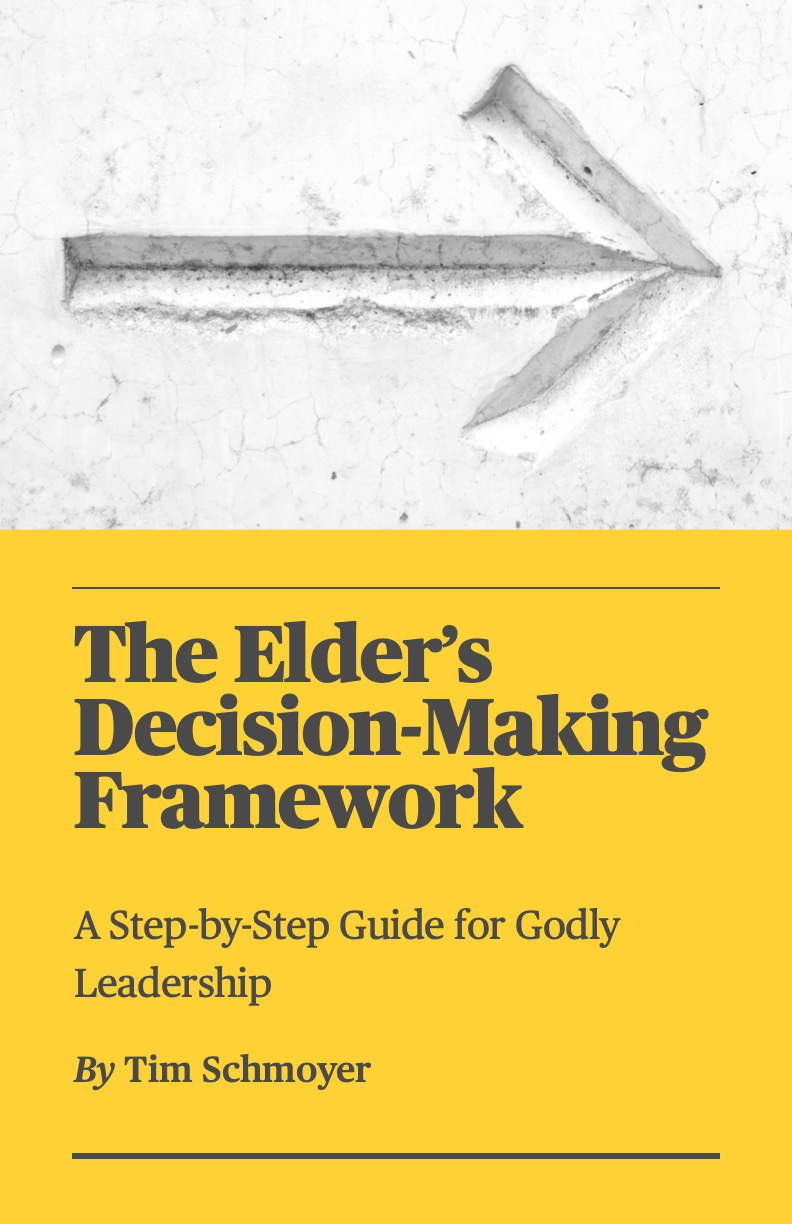
It’s not a formula. It’s a way of seeing what’s actually at stake in the decisions you’re already making.
Get the free guide in your welcome email when you subscribe to, “Elder My City.”
Every week I write about what it looks like to develop elder-worthy character through the decisions you’re already making in your marriage, with your kids, in your business, and in your community. Just honest wrestling with what Scripture says and how it applies to real life.
If you’re a man who wants more than “good dad” as his ceiling, I’d love to have you on the journey.
If you prefer to listen instead of read, I talk through every blog post, often with more details and stories than what works well here. Gotta subscribe via email to get the free guide, though.


Our family of six requires a lot of discernment in where we spend our time currency. Completely understand your perspective here.